Inauguration of the Mende to Montpellier road: progress for tram line 5 and development of cycle paths
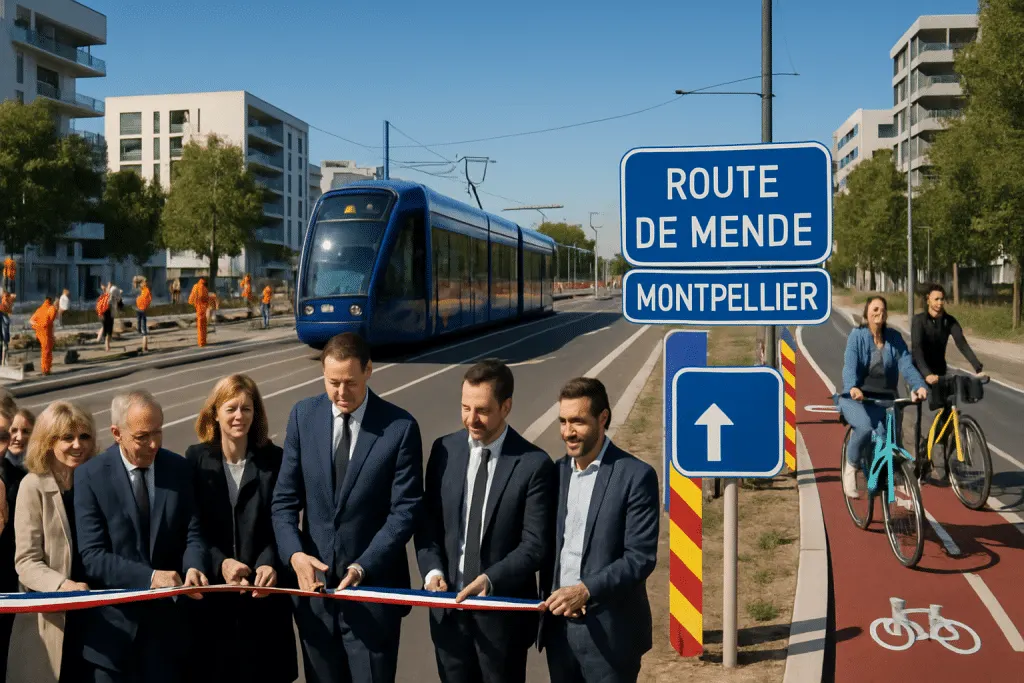
This Thursday, the city of Montpellier witnessed the inauguration of the new developments on the Route de Mende, marking a turning point in the metropolitan area’s urban development. Particular emphasis was placed on the integration of cycle paths and the reintroduction of dual vehicular traffic, all in conjunction with the future tram line 5, which will extend from Clapiers to Lavérune. A look back at this major event for the residents of Montpellier. Urban Transformation: An Ambitious ProjectDuring this major event, Mayor Michaël Delafosse, accompanied by Julie Frêche and local elected officials, inaugurated the transformed Route de Mende. This ambitious project, which is part of Montpellier’s sustainable development agenda, has allowed this artery to be rediscovered in a new light. The cycle paths, now available for nearly five kilometers, offer cyclists a safe and dedicated route, spanning the distance between Place de la Voie-Domitienne and the Clapiers P+ Tram. Promoting Cycling: A Wise Choice With more than 20 kilometers of added cycle paths, the existing network allows users to travel efficiently and safely. Michaël Delafosse emphasized the importance of this development in encouraging cycling, which is not only beneficial for the environment but also for public health. Wide, safe sidewalks have also been created for pedestrians to ensure optimal accessibility. Return to Two-Way Traffic At the same time, the Route de Mende has returned to its original operation thanks to the reintroduction of two-way traffic between Place de la Voie-Domitienne and Rue de l’Hortus. This measure improves traffic flow and responds to a wish expressed by many residents. Although an impact on traffic is expected, particularly with the arrival of theTram line 5, scheduled for December 2025, this configuration allows for better traffic and public transportation management. Line 5: a promising future for Montpellier This inauguration is part of the overall project for tram line 5, which will connect Clapiers to Lavérune. Scheduled to be operational by the end of 2025, this line will relieve congestion in the city center while ensuring seamless connectivity between major urban centers such as the universities, Jeu-de-Paume, Ovalie, and Montcalm. Within this dynamic framework, Montpellier’s urban development not only improves transportation infrastructure but also promotes a reduction in its carbon footprint.
Related reading : Tram line 5: just 10 days until its official inauguration and the start of service
With this inauguration, Montpellier continues to set an example in sustainable mobility and urban planning.
/la-ligne-5-de-tramway-a-montpellier-se-devoile-neuf-mois-avant-son-inauguration/
Read next
 News from the Montpellier region
Production vidéo à Montpellier : pourquoi les entreprises locales s’y mettent toutes
Montpellier est l’une des métropoles françaises les plus dynamiques en matière de création d’entreprises. Start-up de la
 News from the Montpellier region
Moving to Montpellier: how to manage your housing transition
Every year, thousands of newcomers settle in Montpellier. International students, young professionals, families seeking
 News from the Montpellier region
Montpellier: Collision between a car and a tram causes a derailment; the driver of the vehicle flees the scene; traffic is severely disrupted.
Montpellier: Car-Tram Collision, Derailment, and Traffic Disruptions An unusual incident occurred this Friday, January 6